
Welcome toNuisance Wildlife
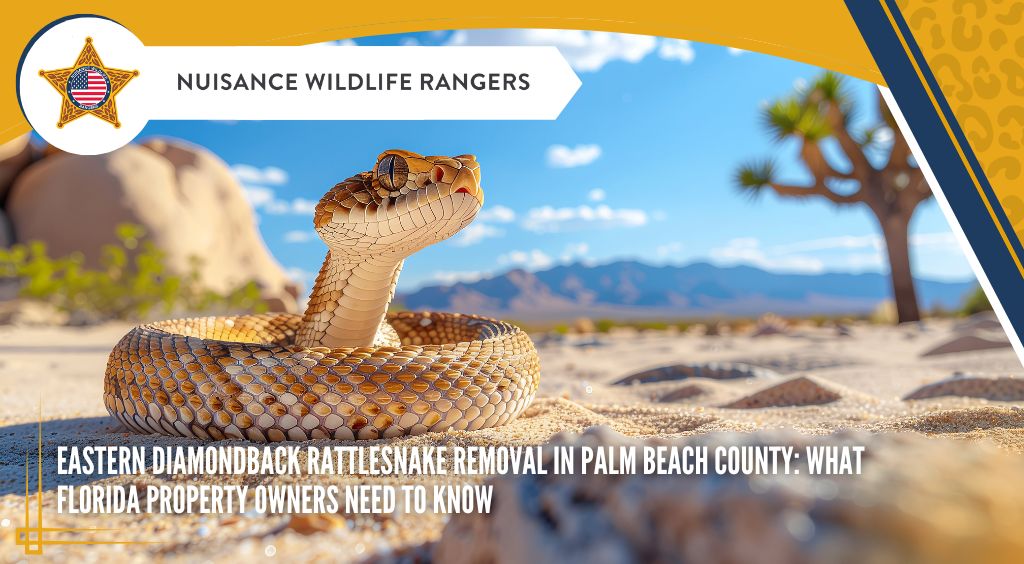
The Eastern Diamondback Rattlesnake (Crotalus adamanteus) is one of the most recognizable and potentially dangerous snakes found in Florida. As development continues across Palm Beach County, more homeowners are reporting encounters with these large venomous snakes in residential neighborhoods, backyards, golf communities, and natural areas.
If you have seen an Eastern Diamondback Rattlesnake on your property, professional Eastern Diamondback Rattlesnake removal in Florida is the safest solution. Understanding their behavior, habitat, and the risks they pose can help reduce human encounters and protect both people and wildlife.
The eastern diamondback rattlesnake is the largest rattlesnake species in North America. Adult eastern diamondbacks typically measure between three and six feet long, although some individuals exceed seven feet. They are easily identified by the dark diamond-shaped patterns running down their backs and the distinctive rattle at the end of the tail. According to the Florida Fish and Wildlife Conservation Commission (FWC), the species can reach lengths of up to eight feet.[1]
The species is native to the southeastern United States, including Florida, Georgia, Alabama, Mississippi, North Carolina, South Carolina, and eastern Louisiana. Florida supports some of the largest remaining populations of this species.
While many people believe rattlesnakes are aggressive, that is largely a misconception. When eastern diamondbacks feel threatened, they usually display a defensive posture by coiling their bodies and rattling their tails. In most cases, they prefer to flee rather than engage with humans.
Palm Beach County continues to experience rapid residential and commercial development. As natural habitats disappear, wildlife is increasingly forced into closer contact with humans.
Habitat loss remains one of the primary threats to eastern diamondbacks. The FWC identifies habitat degradation, fragmentation, road mortality, and human persecution as major factors affecting the species throughout Florida.
Historically, eastern diamondbacks occupied large areas of pine flatwoods, longleaf pine habitats, coastal scrub, and barrier islands. These habitats are now fragmented by roads, housing developments, and commercial construction. As a result, snake encounters are becoming more common in communities throughout Palm Beach County and West Palm Beach.
Properties bordering natural preserves, golf courses, canals, and undeveloped land often experience higher levels of wildlife activity, including rattlesnakes.
Like all reptiles, rattlesnakes are cold-blooded animals that rely on environmental conditions to regulate their body temperatures. During hot weather, they seek shelter in cool hiding places.
Common shelter locations include:
FWC research shows that eastern diamondbacks frequently use gopher tortoise burrows, armadillo burrows, stump holes, and root channels for shelter.
In residential neighborhoods, a cluttered yard can unintentionally create an ideal snake habitat. Rodents, rats, rabbits, and other prey species attract snakes looking for food.
Among Florida’s venomous snakes, the eastern diamondback rattlesnake is often considered one of the most dangerous due to its large size and potent venom.
A bite from a diamondback rattlesnake is a serious medical emergency. Symptoms can include severe pain, swelling, tissue damage, bleeding disorders, and other complications.
Fortunately, bites are relatively uncommon because these snakes tend to avoid people whenever possible. Most bites occur when someone attempts to capture, kill, or handle the snake.
If you encounter a rattlesnake:
Experts estimate that approximately 7,000 to 8,000 venomous snake bites occur annually in the United States, but fatalities remain rare when medical treatment is received promptly.
Understanding seasonal behavior can help homeowners anticipate periods of increased snake activity.
As temperatures warm, rattlesnakes become more active after winter inactivity. They begin hunting prey and searching for mates.
Peak mating season occurs during late summer and fall. During this period, males travel greater distances while searching for females. This movement often increases the likelihood of human encounters.
Although Florida winters are mild, rattlesnakes often spend more time in burrows and sheltered locations during cooler weather.
Because Palm Beach County experiences warm temperatures year-round, snake activity can occur during any season.
Not every snake observed on a property indicates an infestation. However, recurring sightings may suggest favorable habitat conditions.
Warning signs include:
Since eastern diamondbacks feed heavily on rodents, controlling rats and other prey animals can reduce snake activity around homes.
When a venomous snake is discovered on residential or commercial property, professional snake removal is strongly recommended.
Licensed wildlife removal specialists understand snake behavior and have the proper equipment to safely handle venomous species.
Professional snake removal services typically include:
Attempting DIY snake trapping can be extremely dangerous when dealing with venomous snakes.
Many residents mistakenly contact animal control for every snake sighting. However, animal control agencies may not always provide direct snake removal services. Wildlife removal professionals are often the fastest and safest option for urgent situations.
Dogs are particularly vulnerable during snake encounters because they naturally investigate unfamiliar animals.
To reduce risk:
Children should also be taught never to approach a snake, even if it appears dead or inactive.
Complete elimination of snakes is impossible in Florida, but property owners can significantly reduce the likelihood of encounters.
Effective prevention strategies include:
Since rodents are primary prey, reducing food sources can discourage snakes from remaining nearby.
Clean up:
Inspect structures for gaps where wildlife may enter.
Keep shrubs trimmed and grass short to reduce cover and prevent snakes from being attracted to your home.
Monitor gopher tortoise burrows and other wildlife burrows near developed areas while following all wildlife regulations.
Although many people fear rattlesnakes, they play an important role in Florida ecosystems. Eastern diamondbacks help control populations of rats, rabbits, and other small animals.
The species has experienced population declines throughout portions of its range due to habitat loss, road mortality, and historical practices such as rattlesnake roundups. FWC research documented 1,663 recent records across Florida, but notes that populations have disappeared from some urbanized regions of the southeastern peninsula.[1]
Responsible snake removal focuses on protecting people while supporting wildlife conservation whenever possible.
If an eastern diamondback rattlesnake is observed on your property:
Most rattlesnakes will flee when given the opportunity. However, when a venomous snake remains near homes, businesses, schools, or recreational areas, professional removal is often necessary to protect public safety.
Eastern diamondback rattlesnake removal in Palm Beach County requires experience, proper equipment, and an understanding of snake behavior. These venomous reptiles are an important part of Florida’s wildlife, but they can create serious safety concerns when they enter residential communities.
Whether you live in West Palm Beach, a coastal neighborhood near the barrier islands, or a rural area bordering natural habitat, prompt professional snake removal can help protect your family, pets, and property. By reducing attractants, maintaining your yard, and contacting qualified removal services when necessary, you can safely coexist with Florida’s wildlife while minimizing the risk of dangerous encounters.
Contact Nuisance Wildlife Rangers for more information on our snake removal services in Florida.
The cost of snake removal services varies depending on factors such as the snake’s location, accessibility, emergency response requirements, and whether additional exclusion or prevention work is needed. Most wildlife removal companies provide an inspection and quote before beginning removal.
Yes. The Eastern Diamondback Rattlesnake is protected from unregulated commercial harvest in Florida. While homeowners may take action to protect themselves in certain situations, wildlife regulations can be complex. It is best to contact a licensed wildlife removal professional who understands current Florida laws regarding venomous snake capture and relocation.
Unlike some snake species, eastern diamondbacks are primarily ground-dwelling reptiles. They are not known for regularly climbing trees or vertical structures. However, they can move through landscaping, under fences, and across a variety of terrain while searching for food, shelter, or mates.
Keep a safe distance and prevent others from approaching the area. Do not attempt to scare the snake into the water or trap it yourself. Most rattlesnakes near pools are simply passing through or seeking a cooler environment. Contact a professional snake removal company to safely assess and remove the animal if necessary.
They can. If a property provides reliable food sources, shelter, and suitable habitat, the same snake or other rattlesnakes may continue to use the area. This is why long-term prevention measures are just as important as removing the individual snake that was observed.
The safest approach is to avoid making your own identification. While eastern diamondbacks have distinctive diamond-shaped markings and a rattle on the end of the tail, many non-venomous species share similar colors and patterns. Misidentification is common, so any unknown snake should be treated cautiously until evaluated by a trained wildlife professional.
References:
 Call Now
