
Welcome toNuisance Wildlife
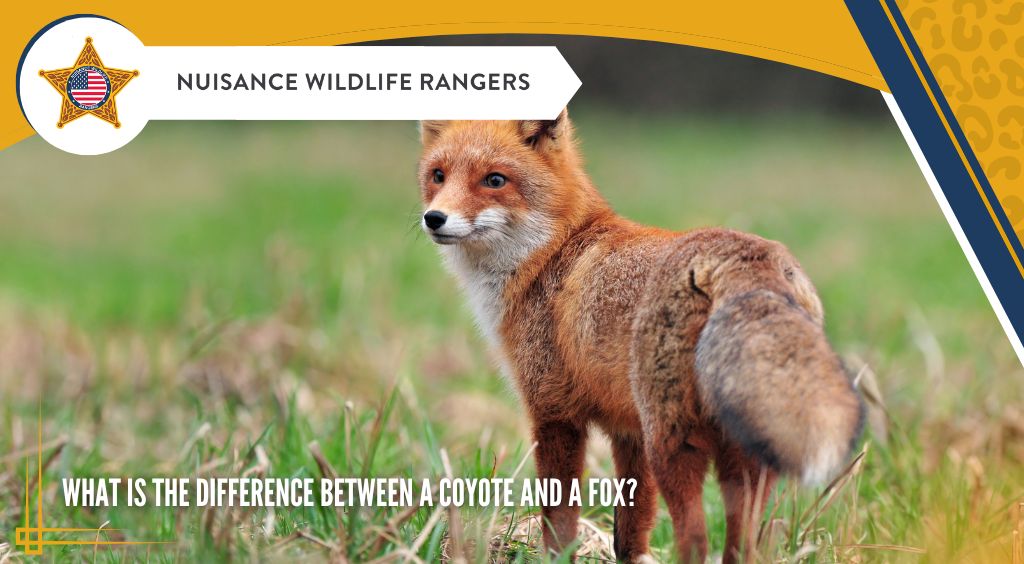
If you’ve spotted a wild animal in your neighborhood or near your property in Florida, it’s easy to feel unsure about what you’re dealing with. Many people confuse a coyote with a fox, especially at a distance. While both are part of the canine family and share similar features, there are important differences that affect how they behave, what they eat, and how they interact with humans.
Understanding these key differences is especially important if you’re dealing with wildlife issues around your home. This guide breaks down everything you need to know in clear, practical terms. If you need wildlife removal services, find fast, expert services by contacting Nuisance Wildlife Rangers.
Coyotes and foxes are both wild canines, meaning they belong to the same broader biological family as the domestic dog and even the gray wolf. However, they belong to different genera. Coyotes belong to the genus Canis (specifically Canis latrans), while foxes belong to the genus Vulpes.
Although they are closely related, their size, behavior, and habitat preferences vary significantly. One of the easiest ways to identify a coyote vs fox is by looking at their size and proportions.
The red fox is the most common fox species in North America, while gray foxes (often called gray foxes) are also found in Florida. If the animal looks similar in size to a medium dog, it’s likely a coyote. If it’s closer to a cat in size, it’s probably a fox.
Physical features are another reliable way to identify these animals. Here are some of the most significant differences between the physical features of foxes and coyotes.
These differences in coat color and texture are often the first thing people notice when trying to identify a wild animal.
Both species are highly adaptable, but their habitat preferences differ slightly. Here is an overview of where you’re most likely to find coyotes and foxes.
A major difference is how comfortable they are around humans. Coyotes are increasingly bold and often spotted in neighborhoods, while foxes tend to avoid direct contact.
According to the Florida Fish and Wildlife Conservation Commission (FWC), the coyote population has expanded across all 67 Florida counties, demonstrating their adaptability in both urban and wild environments.
While foxes and coyotes share similarities, there are significant differences between them.
One surprising difference involves climbing. Coyotes do not climb trees, while gray foxes are one of the only canines that climb trees. Gray foxes use trees to escape predators, rest, and even hunt. If you notice an animal climbing or hanging around trees, it is almost certainly a gray fox.
There are some differences in how these animals hunt, too. Both animals are predators, but their hunting habits differ.
Coyotes are more powerful and capable of taking down larger prey, while foxes stick to smaller food sources. According to USDA Wildlife Services, coyotes account for over 60% of livestock predation losses in the U.S., underscoring their role as apex predators.
While coyotes and foxes may be hard to tell apart, the way these animals move can help you identify them.
Coyotes have a distinctive, steady trot. They often move with purpose across open ground. Foxes, on the other hand, are quicker and more agile. Their movements are more erratic and playful. Generally, foxes often appear more “light on their feet,” while coyotes move with a more direct, efficient gait.
Coyotes often travel in pairs or small family groups. They can form packs when hunting larger prey. They typically maintain a strong family structure during breeding season. Coyotes are more social overall, which can make them more noticeable in certain areas.
Foxes are typically more solitary, usually hunting alone–except during mating season.
Understanding breeding season patterns is important for wildlife control.
During these periods, both animals become more territorial and may be seen more frequently around homes.
Coyotes and foxes differ in how they interact with humans. This is one of the most important differences for homeowners.
Coyotes are more likely to enter developed areas and are known to prey on pets such as cats and small dogs. Due to habitat loss and other factors, coyotes are increasingly active in suburban neighborhoods.
Foxes generally avoid humans, are rarely aggressive, and are less of a direct threat to pets. The Humane Society notes that while both animals can live near humans, coyotes are far more likely to cause conflicts due to their size and hunting ability.
It’s very common for people to confuse these animals, especially at night or from a distance.
Reasons they are mistaken:
However, once you know what to look for—size, tail shape, and behavior—the difference becomes much clearer.
If you’re dealing with wildlife around your property, correctly identifying the species is critical. When trying to identify a coyote or fox, watch for these clues:
If you can safely observe from a distance, these traits will help you make an accurate identification.
While coyotes and foxes are closely related members of the canine family, their differences are significant—especially in behavior, size, and risk to humans and pets. For Florida homeowners, understanding these differences isn’t just interesting—it’s practical. It helps you respond appropriately, protect your property, and know when to call a professional.
If you’ve noticed increased wildlife activity around your home, especially involving predators, it’s best to act quickly. Find quick, professional wildlife removal services by contacting the experts at Nuisance Wildlife Rangers. Contact our team to learn more about our services or to schedule a consulation or removal now.
Coyotes pose a greater risk to pets, especially small dogs and cats. Their size and ability to hunt larger prey make them more likely to attack animals in residential areas. Foxes, on the other hand, tend to avoid confrontation and rarely target pets unless food is scarce.
If you spot a wild animal on your property, do not approach it. Make loud noises, turn on outdoor lights, and keep a safe distance. Remove food sources such as pet food, trash, or fallen fruit. If the animal continues to return or shows no fear of humans, contact a professional wildlife removal service.
Yes, both animals can carry diseases such as rabies and mange, as well as parasites. While transmission to humans is rare, pets are more vulnerable. Keeping pets vaccinated and avoiding direct contact with wildlife is the best way to reduce risk.
Urban expansion and loss of natural habitat have pushed many wild canines into developed areas. These animals are highly adaptable and often drawn to easy food sources such as garbage, pet food, and small animals. Florida’s growing population has increased these encounters in recent years.
Both animals are generally more active at dawn and dusk, but they can be seen during the day—especially in areas with less human activity. Daytime sightings do not always indicate a problem, but animals that appear unusually bold or aggressive should be reported.
Florida wildlife laws regulate how these animals can be handled. In most cases, removal must be done by licensed professionals who follow state guidelines. Attempting to trap or relocate a wild animal without proper authorization can lead to fines or unintended harm to the animal.
 Call Now
